De Burcht
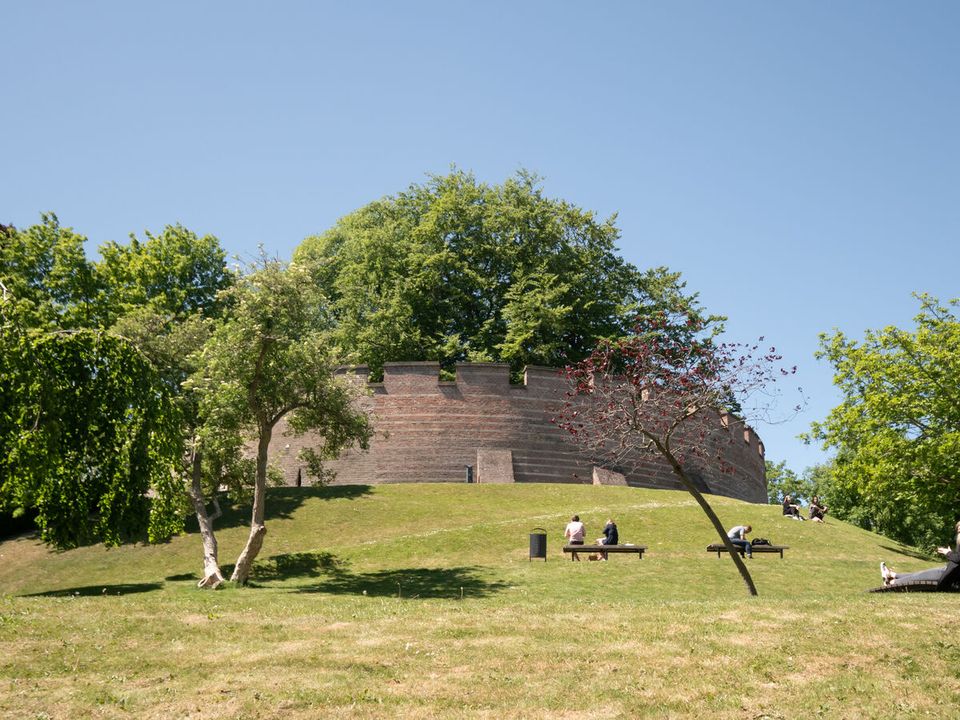
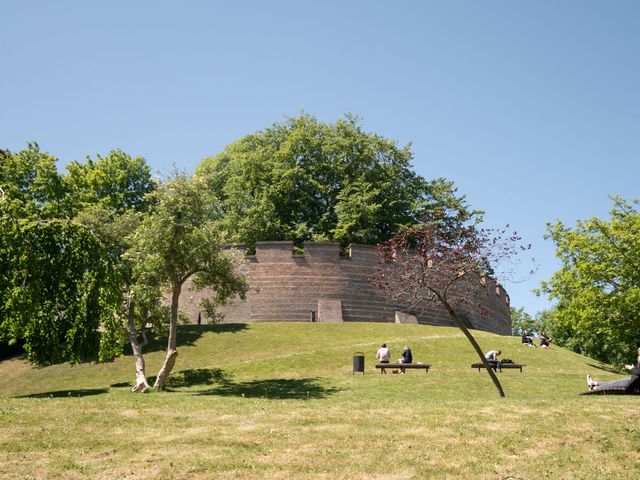
Leiden Castle is one of the oldest surviving examples of a castle in the Netherlands. The Castle stands on a motte, an artificial hill, and was part of a so-called motte castle.
A Strategic Site with Early Roots
The history of the Burcht begins in the 9th and 10th centuries, when a palisaded refuge — the “Leitheriburch” — was constructed on this spot. It served as a protected place where people and their livestock could seek safety in times of danger. Around the year 1000 a wooden building already stood here, and in the centuries that followed the mound was gradually raised to roughly 10 metres above its surroundings.
Under Count Dirk VI, the wooden enclosure was replaced by a tuffstone ring wall. The location was chosen strategically: precisely at the point where the rivers Rhine, Mare and Vliet converge.
Medieval Power and Remarkable Stories
The Burcht appears in written sou…
A Strategic Site with Early Roots
The history of the Burcht begins in the 9th and 10th centuries, when a palisaded refuge — the “Leitheriburch” — was constructed on this spot. It served as a protected place where people and their livestock could seek safety in times of danger. Around the year 1000 a wooden building already stood here, and in the centuries that followed the mound was gradually raised to roughly 10 metres above its surroundings.
Under Count Dirk VI, the wooden enclosure was replaced by a tuffstone ring wall. The location was chosen strategically: precisely at the point where the rivers Rhine, Mare and Vliet converge.
Medieval Power and Remarkable Stories
The Burcht appears in written sources for the first time in the 12th century. Castellans such as Alwinus Castellanus and later Jacob of Leiden had their seat here and held important privileges, including the right to collect taxes and appoint local officials such as the bailiff and aldermen.
The Burcht also played a role in significant historical events, including the conflict surrounding Ada of Holland (1203–1204). During this Loon War, the structure suffered heavy damage and was later repaired using monastery bricks. Around 1275 the ring wall was rebuilt once again, possibly commissioned by Floris V.
Archaeological Discoveries
Extensive archaeological research has been conducted at the Burcht over the years. Excavations confirm that the mound is entirely man-made and consists of several construction phases dating back to the early Middle Ages. Although individual finds — such as a Roman coin — occasionally suggest earlier activity, the structural evidence shows that the hill originated in the 9th or 10th century.
Visit the Burcht
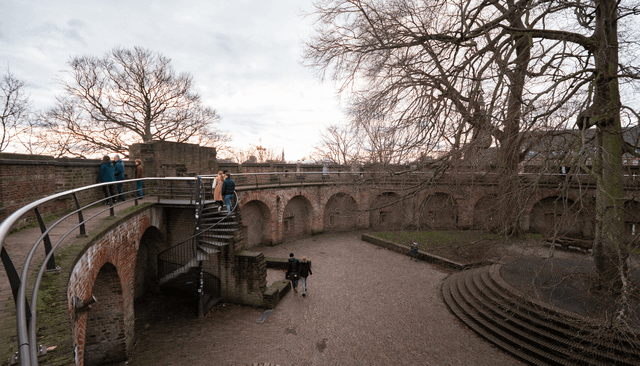
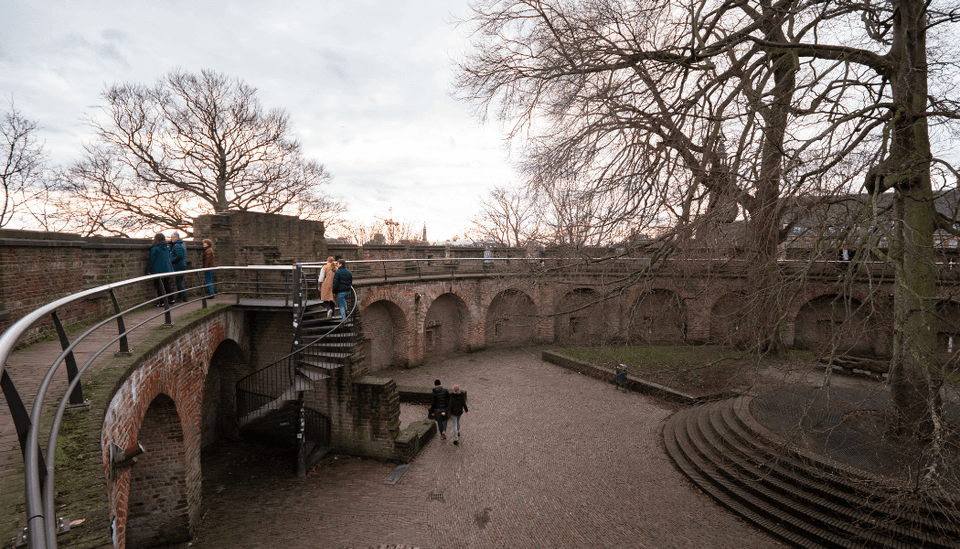
The Burcht is freely accessible and makes an excellent starting point for exploring Leiden. From the wall walk, you can enjoy a unique panoramic view of the historic city centre. The entrance is reached through the elegant wrought-iron gate from 1653.
A place with nearly twelve centuries of history, right in the heart of Leiden.